

Editorial and Peer Review Process
Journal Information
Contents
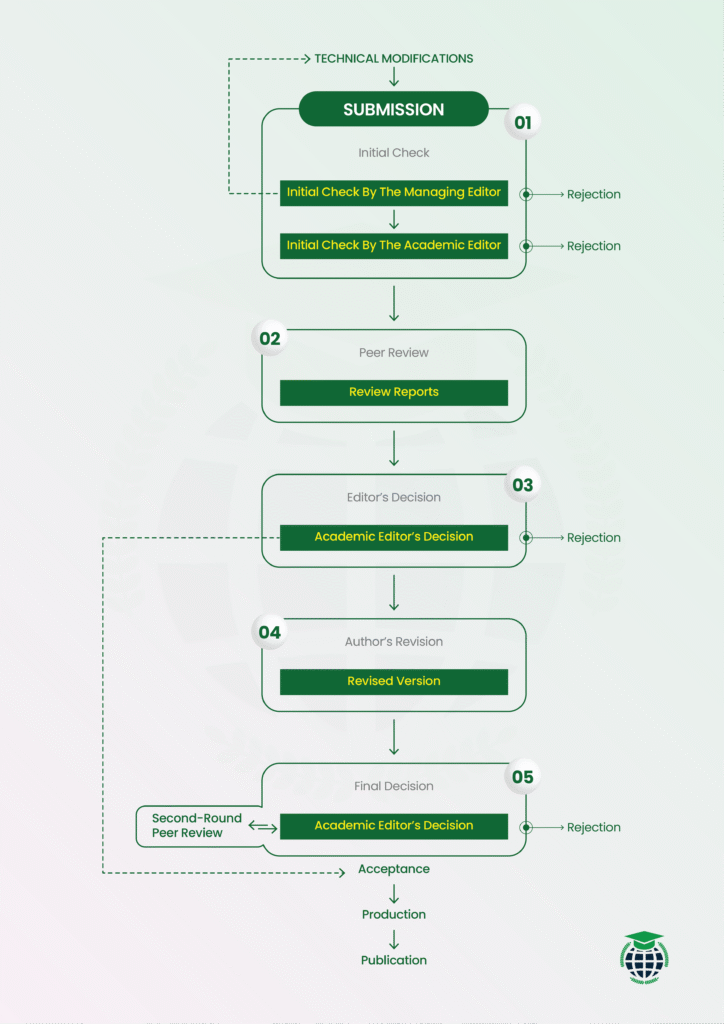
Initial Check
The first review step is an initial check of the submitted manuscript carried out by the managing editor to assess:
★ The suitability of the manuscript with regards to the scope of the journal.
★ The appropriateness of the format of the manuscript.
★ The similarity between the manuscript and existing literature by iThenticate.
Manuscripts that fail to meet the expected standard will be rejected at this stage and may be returned to authors for modification.
Eligible manuscripts are assigned to an Academic Editor who is usually an Editor-in-Chief. In some cases, an Editor-in-Chief may appoint another Editorial Board Member, a Guest Editor, or another expert in the field as the Academic Editor, after disclosing conflicts of interest according to the COPE Guidelines, The Academic Editor evaluates the manuscript regarding its novelty, scientific soundness, and ethical issues. If the manuscript is not of sufficient quality or is outside the journal’s scope, it may be rejected without further processing.
Peer Review
The journal adopts a single-blind peer review model. All manuscripts (except for Editorials released by the Editors) undergo rigorous review. Single-blind peer review means that reviewers know the identities of authors, but the identities of reviewers are hidden from authors.
After the initial check, experts in the relevant field are invited to review the manuscript. Details of reviewer selection are available in the Peer Review Policy
The reviewer is generally required to complete the review within 14 days of accepting the invitation. The reviewer will assess the scientific validity, novelty, and significance of the manuscript and provide a review report with specific comments and an overall recommendation (“Acceptance,” “Minor Revision,” “Major Revision,” or “Rejection”).
At least two review reports are collected and then sent to the Academic Editor for consideration. Detailed guidelines for reviewers are available at Peer Review Guidelines
Special issue manuscripts must meet the same quality standards as regular papers. All special issue manuscripts undergo peer review (except for Editorials released by the Editors). The Editor-in-Chief is responsible for final content control and supervision of Guest Editors. More information is available at Guest Editor Guidelines
Editor Decision
After review reports are collected, the Academic Editor makes one of the following recommendations:
★ Acceptance: The manuscript proceeds to the production process.
★ Revision: Authors are invited to revise the manuscript based on reviewer/editor comments. Revised versions may undergo further review.
★ Rejection: The manuscript is declined.
If the Academic Editor is not the Editor-in-Chief, acceptance/rejection decisions are subject to final approval by the Editor-in-Chief.
Post Acceptance
Each accepted manuscript undergoes production, including language editing, copy editing, and format conversion before publication.
Appeals and Complaints
Authors have the right to appeal editorial decisions or review reports. Please contact the editorial office at editor@academicsociety.org to submit appeals. Complaints about the editorial process or publication ethics should be directed to the editorial office.
For ethics-related complaints, the journal follows the guidelines of the Committee on Publication Ethics (COPE).