

Future perspectives: targeting fibroblast growth factor receptor 1 to enhance the efficacy of immunotherapy
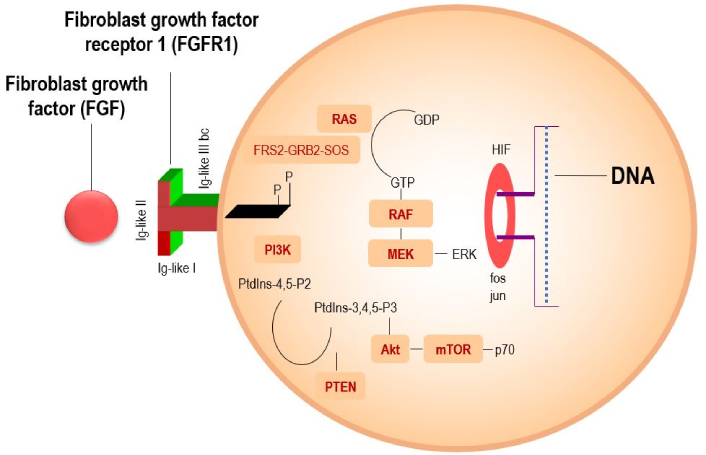
Fibroblast growth factor receptor 1 (FGFR1) plays a critical role in the progression of various cancers through its involvement in cell proliferation, survival, and differentiation. More recently, FGFR1 has been implicated in the mechanisms of immune evasion, particularly its role in resistance to immune checkpoint inhibitors (ICIs) such as pembrolizumab and nivolumab. Targeting FGFR1 with monoclonal antibodies and tyrosine kinase inhibitors has emerged as a promising therapeutic strategy to enhance ICI efficacy by altering the tumor microenvironment and countering immune suppression. Preclinical studies demonstrate that combining FGFR1 inhibitors, such as the novel monoclonal antibody OM-RCA-01, with ICIs significantly improves antitumor activity, enhancing T cell responses and cytokine production. This article explores the role of FGFR1 in cancer biology, its contribution to immunotherapy resistance, and the therapeutic potential of targeting FGFR1 to enhance the efficacy of ICIs.
Fibroblast growth factor receptor 1 (FGFR1) plays a critical role in the progression of various cancers through its involvement in cell proliferation, survival, and differentiation. More recently, FGFR1 has been implicated in the mechanisms of immune evasion, particularly its role in resistance to immune checkpoint inhibitors (ICIs) such as pembrolizumab and nivolumab. Targeting FGFR1 with monoclonal antibodies and tyrosine kinase inhibitors has emerged as a promising therapeutic strategy to enhance ICI efficacy by altering the tumor microenvironment and countering immune suppression. Preclinical studies demonstrate that combining FGFR1 inhibitors, such as the novel monoclonal antibody OM-RCA-01, with ICIs significantly improves antitumor activity, enhancing T cell responses and cytokine production. This article explores the role of FGFR1 in cancer biology, its contribution to immunotherapy resistance, and the therapeutic potential of targeting FGFR1 to enhance the efficacy of ICIs.
Fibroblast growth factor receptor 1 (FGFR1) plays a critical role in the progression of various cancers through its involvement in cell proliferation, survival, and differentiation. More recently, FGFR1 has been implicated in the mechanisms of immune evasion, particularly its role in resistance to immune checkpoint inhibitors (ICIs) such as pembrolizumab and nivolumab. Targeting FGFR1 with monoclonal antibodies and tyrosine kinase inhibitors has emerged as a promising therapeutic strategy to enhance ICI efficacy by altering the tumor microenvironment and countering immune suppression. Preclinical studies demonstrate that combining FGFR1 inhibitors, such as the novel monoclonal antibody OM-RCA-01, with ICIs significantly improves antitumor activity, enhancing T cell responses and cytokine production. This article explores the role of FGFR1 in cancer biology, its contribution to immunotherapy resistance, and the therapeutic potential of targeting FGFR1 to enhance the efficacy of ICIs.
Fibroblast growth factor receptor 1 (FGFR1) plays a critical role in the progression of various cancers through its involvement in cell proliferation, survival, and differentiation. More recently, FGFR1 has been implicated in the mechanisms of immune evasion, particularly its role in resistance to immune checkpoint inhibitors (ICIs) such as pembrolizumab and nivolumab. Targeting FGFR1 with monoclonal antibodies and tyrosine kinase inhibitors has emerged as a promising therapeutic strategy to enhance ICI efficacy by altering the tumor microenvironment and countering immune suppression. Preclinical studies demonstrate that combining FGFR1 inhibitors, such as the novel monoclonal antibody OM-RCA-01, with ICIs significantly improves antitumor activity, enhancing T cell responses and cytokine production. This article explores the role of FGFR1 in cancer biology, its contribution to immunotherapy resistance, and the therapeutic potential of targeting FGFR1 to enhance the efficacy of ICIs.
Fibroblast growth factor receptor 1 (FGFR1) plays a critical role in the progression of various cancers through its involvement in cell proliferation, survival, and differentiation. More recently, FGFR1 has been implicated in the mechanisms of immune evasion, particularly its role in resistance to immune checkpoint inhibitors (ICIs) such as pembrolizumab and nivolumab. Targeting FGFR1 with monoclonal antibodies and tyrosine kinase inhibitors has emerged as a promising therapeutic strategy to enhance ICI efficacy by altering the tumor microenvironment and countering immune suppression. Preclinical studies demonstrate that combining FGFR1 inhibitors, such as the novel monoclonal antibody OM-RCA-01, with ICIs significantly improves antitumor activity, enhancing T cell responses and cytokine production. This article explores the role of FGFR1 in cancer biology, its contribution to immunotherapy resistance, and the therapeutic potential of targeting FGFR1 to enhance the efficacy of ICIs.
Fibroblast growth factor receptor 1 (FGFR1) plays a critical role in the progression of various cancers through its involvement in cell proliferation, survival, and differentiation. More recently, FGFR1 has been implicated in the mechanisms of immune evasion, particularly its role in resistance to immune checkpoint inhibitors (ICIs) such as pembrolizumab and nivolumab. Targeting FGFR1 with monoclonal antibodies and tyrosine kinase inhibitors has emerged as a promising therapeutic strategy to enhance ICI efficacy by altering the tumor microenvironment and countering immune suppression. Preclinical studies demonstrate that combining FGFR1 inhibitors, such as the novel monoclonal antibody OM-RCA-01, with ICIs significantly improves antitumor activity, enhancing T cell responses and cytokine production. This article explores the role of FGFR1 in cancer biology, its contribution to immunotherapy resistance, and the therapeutic potential of targeting FGFR1 to enhance the efficacy of ICIs.
Fibroblast growth factor receptor 1 (FGFR1) plays a critical role in the progression of various cancers through its involvement in cell proliferation, survival, and differentiation. More recently, FGFR1 has been implicated in the mechanisms of immune evasion, particularly its role in resistance to immune checkpoint inhibitors (ICIs) such as pembrolizumab and nivolumab. Targeting FGFR1 with monoclonal antibodies and tyrosine kinase inhibitors has emerged as a promising therapeutic strategy to enhance ICI efficacy by altering the tumor microenvironment and countering immune suppression. Preclinical studies demonstrate that combining FGFR1 inhibitors, such as the novel monoclonal antibody OM-RCA-01, with ICIs significantly improves antitumor activity, enhancing T cell responses and cytokine production. This article explores the role of FGFR1 in cancer biology, its contribution to immunotherapy resistance, and the therapeutic potential of targeting FGFR1 to enhance the efficacy of ICIs.
Fibroblast growth factor receptor 1 (FGFR1) plays a critical role in the progression of various cancers through its involvement in cell proliferation, survival, and differentiation. More recently, FGFR1 has been implicated in the mechanisms of immune evasion, particularly its role in resistance to immune checkpoint inhibitors (ICIs) such as pembrolizumab and nivolumab. Targeting FGFR1 with monoclonal antibodies and tyrosine kinase inhibitors has emerged as a promising therapeutic strategy to enhance ICI efficacy by altering the tumor microenvironment and countering immune suppression. Preclinical studies demonstrate that combining FGFR1 inhibitors, such as the novel monoclonal antibody OM-RCA-01, with ICIs significantly improves antitumor activity, enhancing T cell responses and cytokine production. This article explores the role of FGFR1 in cancer biology, its contribution to immunotherapy resistance, and the therapeutic potential of targeting FGFR1 to enhance the efficacy of ICIs.
Fibroblast growth factor receptor 1 (FGFR1) plays a critical role in the progression of various cancers through its involvement in cell proliferation, survival, and differentiation. More recently, FGFR1 has been implicated in the mechanisms of immune evasion, particularly its role in resistance to immune checkpoint inhibitors (ICIs) such as pembrolizumab and nivolumab. Targeting FGFR1 with monoclonal antibodies and tyrosine kinase inhibitors has emerged as a promising therapeutic strategy to enhance ICI efficacy by altering the tumor microenvironment and countering immune suppression. Preclinical studies demonstrate that combining FGFR1 inhibitors, such as the novel monoclonal antibody OM-RCA-01, with ICIs significantly improves antitumor activity, enhancing T cell responses and cytokine production. This article explores the role of FGFR1 in cancer biology, its contribution to immunotherapy resistance, and the therapeutic potential of targeting FGFR1 to enhance the efficacy of ICIs.